Yang Li, PhD Researcher Department of Languages and Cultures Ghent University – Horizon Europe “ReConnect China” Project
Introduction
On 1 September 2025, China officially launched its Global Governance Initiative (GGI全球治理倡议), articulating five core principles: sovereign equality, the rule of international law, multilateralism, a people-centred approach, and results-oriented cooperation. The GGI seeks to promote a more just and equitable system of global governance (Ministry of Foreign Affairs of the PRC, 2025d). It stresses that all states—regardless of size—should enjoy equal sovereignty, rejects unilateral sanctions, and advocates for enhanced representation of developing countries through multilateral mechanisms (Government of China, 2025).
This article focuses on China’s positioning of Iran within the framework of the GGI, as defined in the 1 September 2025 announcement. It addresses a central question: does China regard Iran as a serious strategic partner in advancing the GGI, or is Iran’s role relatively marginal when compared to other Middle Eastern countries? Through an analysis of multilateral cooperation, official discourse and the practical constraints of bilateral engagement, this paper argues that while Iran is ideologically aligned with China as a key normative partner, limitations related to geopolitical complexity and economic implementation capacity expose it to the risk of marginalisation within the initiative.
- The Core Principles and Strategic Significance of the Global Governance Initiative
In the context of the current international landscape, the Chinese government has introduced the GGI. Today’s global order can broadly be understood as comprising two parallel structures. The first is a liberal hegemonic order centred around the United States, characterised by the promotion of democracy, free markets, and a rules-based international system. The second is a “bounded order” led by China, which prioritises national sovereignty, development rights, and the principle of non-interference in domestic affairs (Mearsheimer, 2019).
Within this framework, the GGI represents China’s normative blueprint for a “bounded order” that emphasizes sovereignty, equity, and South–South cooperation. Officially, it rests on five key principles: sovereign equality, adherence to international law (especially the UN Charter), inclusive multilateralism, a people-centred governance model, and pragmatic, results-oriented collaboration—where developed nations contribute more, and developing countries work collectively toward shared advancement (Government of China, 2025).
The GGI was launched at a time when the global governance system faces mounting challenges, including intensifying great-power competition, an increase in unilateral sanctions, and persistent development imbalances (World Bank, 2023). In response, China has sought to translate its normative vision—particularly the principles of non-interference and development priority—into operational mechanisms via emerging multilateral platforms such as the SCO and the BRICS group (SCO Secretariat, 2022).
Strategically, the GGI represents an effort to reshape and strengthen international order without direct confrontation with the Western-led system. Through the promotion of multilateralism and South–South cooperation, China aims to enhance the collective agency of developing countries while maintaining a dynamic balance in relations among major powers. This pragmatically driven approach places emphasis on mutual benefit and prioritises collaboration with states whose interests and values align, and with whom political frictions are relatively limited (Aryan, 2022).
- China’s Perception of Iran within the Framework of the GGI
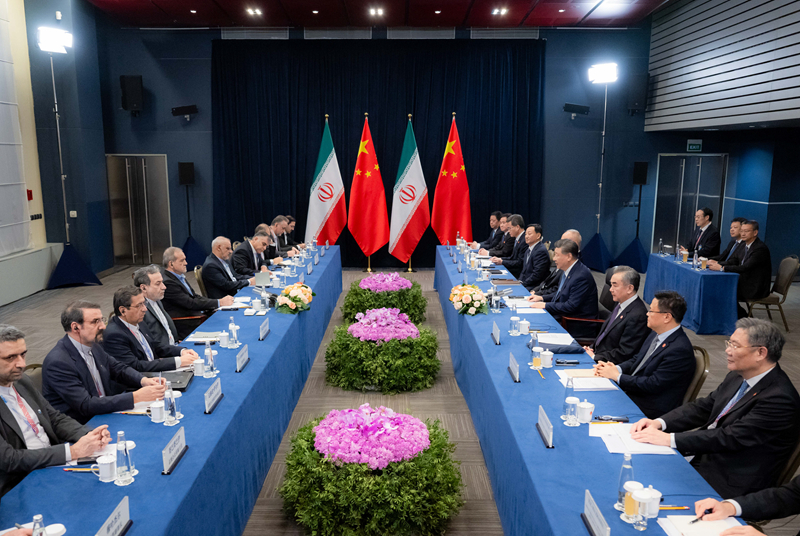
Under the framework of the GGI, officially launched on 1st September 2025, China has positioned Iran as an important participant and supporting force in its vision for global governance reform. At the core of this bilateral engagement lies a pragmatic partnership grounded in shared interests. Chinese official discourse has explicitly recognised Iran’s role. During his meeting with Iranian President Masoud Pezeshkian in September 2025, President Xi Jinping 习近平stated that China was willing to work with Iran and the wider international community to build a fair and equitable system of global governance and a shared future for mankind. Xi also praised Iran’s constructive role in the Shanghai Cooperation Organisation (SCO 上海合作组织), and called for deeper coordination within multilateral frameworks (MFA of the PRC, 2025b). In response, President Pezeshkian described the GGI as a “far-sighted initiative” and expressed Iran’s willingness to strengthen strategic alignment with China in opposing hegemonism and promoting global justice (MFA of the PRC, 2025b). A spokesperson for China’s Ministry of Foreign Affairs (MFA) further noted that many developing countries, including Iran, regard the GGI as “timely and necessary”, reflecting a broad consensus and shared aspiration across the Global South (Government of China, 2025). These exchanges indicate that China has actively incorporated Iran into its strategic narrative on the Global South, with both sides aligning closely on key issues such as opposition to unilateral sanctions and the advocacy of sovereign equality.
Following the GGI’s announcement on 1 September, Iran responded promptly by proposing the creation of a regional energy trading platform denominated in Renminbi人民币 during the SCO Tianjin Summit天津峰会. This proposal aligns with the GGI’s core ideas on de-dollarisation and economic sovereignty (MFA of the PRC, 2025c), thereby reinforcing Iran’s position as a proactive contributor to the initiative. Furthermore, China’s role in mediating the Saudi–Iranian rapprochement is widely viewed as a successful demonstration of its Global Security Initiative in action, and illustrates how China has worked with Iran to explore governance models based on dialogue rather than confrontation (Zhou, 2023).
Scholarly analysis on both sides has reinforced the potential for deeper cooperation. Iranian experts, such as Professor Vafaei, Director of the Asia Studies Centre at the University of Tehran, argue that the GGI’s multilateral orientation closely resonates with Iran’s long-standing opposition to great power dominance. He further suggests that the SCO could offer Iran institutional pathways for cooperation in areas such as climate change and energy security (Government of China, 2025). Chinese scholars, including Wu Sike吴思科, have similarly pointed out that the two countries share a common vision for reforming the international order and amplifying the voice of the Global South, forming a basis for coordinated diplomacy in platforms such as the United Nations (China Diplomacy, 2023).
At the multilateral level, the institutional foundations and agenda convergence between China and Iran continue to deepen. Within the UN system, both sides support safeguarding the authority of the United Nations and advocate reasonable reforms to enhance the representation and influence of developing countries (OBOR, 2023). Iranian diplomats have frequently called for breaking the structural monopoly of great powers in global governance — a position closely aligned with China’s normative stance in recent years (MFA of the PRC, 2025a). Iran’s formal accession to the SCO has injected new momentum into areas such as regional counter-terrorism, trade facilitation, and infrastructure connectivity. The 2025 SCO Summit in Tianjin marked a notable moment of Sino-Iranian multilateral coordination (MFA of the PRC, 2025c).
In the context of BRICS expansion, Iran’s entry as a new member further strengthened its institutional engagement with China, with both countries working to promote cooperation among emerging markets and enhance the role of developing countries in global economic governance (OBOR, 2023). Additionally, Iran has actively joined the “Group of Friends of the Global Development Initiative” and maintained close coordination with China in platforms such as the Non-Aligned Movement and the Group of 77, further underscoring their shared direction and complementarity in shaping South–South cooperation (China.com.cn, 2023).
- The Potential Risk of Iran’s Marginalisation within the GGI Framework
While China and Iran exhibit considerable potential for cooperation under the GGI, whether China truly views Iran as a serious and central partner must be assessed within the broader context of China’s strategic posture in the Middle East. From a pragmatic perspective, Iran does feature as one of China’s key partners in advancing global governance reform. Iran’s active participation in the SCO and the expanded BRICS framework, alongside its vocal support for the GGI, has rendered it a relatively reliable actor in promoting China’s multilateral agenda (SCO Secretariat, 2022). China’s support for Iran’s inclusion in such mechanisms underscores its recognition of Iran’s role as a representative of the Global South. Simultaneously, in line with its long-standing principles of non-interference and political non-conditionality, China maintains close economic ties with PersianGulf states such as Saudi Arabia and the United Arab Emirates, viewing the broader Middle Eastern crescent as a critical hub for the Belt and Road Initiative (BRI 一带一路倡议) and the Global Development Initiative (Azizi, 2023).
However, the region’s complex geopolitical realities significantly constrain Iran’s potential role in China’s global governance architecture. Continued sanctions imposed by the West have effectively narrowed the institutional scope of China–Iran cooperation. Although China formally opposes unilateral sanctions, it adopts a cautious approach on sensitive matters such as Iran’s nuclear programme, seeking to avoid direct confrontation with the US-led international order (Garver, 2022). In the energy sector, Iran remains one of China’s top crude oil suppliers. The claim that China imports more than 90% of Iran’s oil exports is supported by multiple recent sources, with data indicating percentages ranging from approximately 89% to 95% in recent years, often exceeding 90% in specific periods(Visual Capitalist, 2025; Foundation for Defense of Democracies, 2025; Asia Times, 2025). In the first half of 2025, China imported an average of 1.38 million barrels per day from Iran, accounting for 13.6% of its total imports (Reuters, 2025a). To mitigate sanctions exposure, China has employed a range of covert strategies, including the use of “dark fleet” shipping and trans-shipment through third countries such as Malaysia (Atlantic Council, 2024). Simultaneously, China continues to diversify its energy supply chains through strengthened partnerships with countries like Saudi Arabia (Zhou, 2023).
It is noteworthy that in the concrete implementation of the GGI, China appears to rely more heavily on core strategic partners such as Russia and Pakistan, while Iran’s contribution has thus far been limited primarily to security and anti-hegemonic discourse, rather than integrated institutional cooperation (Center for Strategic and International Studies, 2025). Moreover, the effectiveness of Iran’s “Look East” policy remains underwhelming. Coupled with domestic economic and governance challenges, this has weakened Iran’s credibility and capacity for sustained engagement in multilateral platforms (Ghaderi, 2023).
In this context, while China and Iran may share a high degree of normative alignment, Iran’s uncertain performance in realpolitik and institutional execution presents a genuine risk of marginalisation within the GGI framework. Its future positioning will largely depend on whether Iran can transform rhetorical support into tangible project delivery and measurable institutional outcomes. Only then can Tehran secure a meaningful voice and lasting presence in China’s global governance strategy.
- Conclusion
As two ancient civilisations situated at the eastern and western flanks of Asia, China and Iran not only share profound historical legacies but also possess the transformative potential to reshape regional and global governance structures. Under the GGI, China has explicitly incorporated Iran into its strategic narrative of the Global South, recognising Tehran’s alignment on key normative pillars such as sovereign equality, multilateralism, and resistance to hegemonic practices.
Institutional pathways for cooperation have already begun to take shape across multiple multilateral platforms, including the SCO, the expanded BRICS framework, and the United Nations. Despite external sanctions and internal structural challenges, Iran continues to demonstrate political will and operational engagement in reimagining global governance.
Looking ahead, Iran holds the potential to strengthen its position as a strategic pillar of China’s GGI by generating more visible, mechanism-driven outcomes in areas such as energy cooperation, connectivity, and development financing. Through such practical and institutional contributions, Iran may further consolidate its role as a credible and proactive actor in advancing a more inclusive, equitable, and multipolar world order in partnership with China.
- Reference
Aryan, H. (2022). China’s Global Governance Initiatives and the Middle East. Journal of Contemporary China, 31(135), 456-472. DOI: 10.1080/10670564.2022.2041234. Retrieved from https://www.tandfonline.com/doi/full/10.1080/10670564.2022.2041234.
Atlantic Council. (2024). The axis of evasion: Behind China’s oil trade with Iran and Russia. Retrieved September 11, 2025, from https://www.atlanticcouncil.org/blogs/econographics/the-axis-of-evasion-behind-chinas-oil-trade-with-iran-and-russia/
Azizi, H. (2023). China’s Balancing Act in the Middle East: The Belt and Road Initiative and Regional Partnerships. Middle East Policy, 30(2), 112-130. DOI: 10.1111/mepo.12745. Retrieved from https://onlinelibrary.wiley.com/doi/10.1111/mepo.12745.
Belt and Road Portal (OBOR). (2023). China-Iran Cooperation in the Belt and Road Initiative: Progress Report 2023. Retrieved from https://eng.yidaiyilu.gov.cn/p/03QJ8K0H.html.
Center for Strategic and International Studies. (2025). China showcases global ambitions at Shanghai Cooperation Organization Summit. Retrieved September 11, 2025, from https://www.csis.org/analysis/china-showcases-global-ambitions-shanghai-cooperation-organization-summit
Garver, J. W. (2022). China and Iran: Ancient Partners in a Post-Imperial World. University of Washington Press.. Retrieved from https://uwapress.uw.edu/book/9780295749826/china-and-iran/.
Ghaderi, F. (2023). Iran’s Look East Policy: Challenges and Domestic Constraints. Iranian Studies, 56(4), 567-585. DOI: 10.1080/00210862.2023.2180001. Retrieved from https://www.tandfonline.com/doi/full/10.1080/00210862.2023.2180001.
Mearsheimer, J. J. (2019). Bound to Fail: The Rise and Fall of the Liberal International Order. International Security, 43(4), 7–50.
Ministry of Foreign Affairs of the People’s Republic of China. (2025a, September 1). Pooling the Strength of the Shanghai Cooperation Organization to Improve Global Governance [Xi Jinping’s speech at SCO Tianjin Summit]. Retrieved September 11, 2025, from https://www.fmprc.gov.cn/mfa_eng/xw/zyxw/202509/t20250901_11699629.html
Ministry of Foreign Affairs of the People’s Republic of China. (2025b, September 2). President Xi Jinping Meets with Iranian President Masoud Pezeshkian. Retrieved September 11, 2025, from https://www.fmprc.gov.cn/mfa_eng/xw/zyxw/202509/t20250902_11700835.html
Ministry of Foreign Affairs of the People’s Republic of China. (2025c, September 1). Concept Paper on the Global Governance Initiative. Retrieved September 11, 2025, from https://www.fmprc.gov.cn/eng/xw/wjbxw/202509/t20250901_11699912.html
Ministry of Foreign Affairs of the People’s Republic of China. (2025d, September 4). The Global Governance Initiative Comes at the Right Time, Points the Way Forward, and Demonstrates Responsibility. Retrieved September 11, 2025, from https://www.fmprc.gov.cn/mfa_eng/wjbzhd/202509/t20250904_11702287.html
Shanghai Cooperation Organisation Secretariat. (2022). Annual Report on SCO Activities 2022. SCO Secretariat. Retrieved from https://eng.sectsco.org/20220915/1020580.html.
World Bank. (2023). Global Economic Prospects: Navigating Uncertainty. Washington, DC: World Bank. Retrieved September 11, 2025, from https://www.worldbank.org/en/publication/global-economic-prospects
Zhou, Y. (2023). China’s Mediation in the Saudi-Iranian Rapprochement: A New Era in Middle East Diplomacy. Asian Journal of Middle Eastern and Islamic Studies, 17(1), 45-62. DOI: 10.1080/25765949.2023.2180000. Retrieved from https://www.tandfonline.com/doi/full/10.1080/25765949.2023.2180000.
Xi, J. (2017, January 18). Work together to build a community of shared future for mankind [Speech at the United Nations Office at Geneva]. Retrieved September 11, 2025, from https://www.fmprc.gov.cn/mfa_eng/zxxx_662805/201701/t20170119_10415677.html
China Diplomacy (2023, March 11). Interview: China’s Role in Middle East Diplomacy and Reforming the International Order. Beijing Daily (via Discourse Power). Retrieved from https://discoursepower.substack.com/p/discourse-power-march-11-2023.
China.com.cn. (2023, March 15). Iran Joins Group of Friends of the Global Development Initiative, Strengthening South-South Cooperation. Retrieved from http://www.china.com.cn/2023-03/15/content_85234567.htm.
Reuters. (2025c, April 14). China’s crude oil imports highest since August 2023 on Iranian surge. Retrieved September 11, 2025, from https://www.reuters.com/markets/commodities/chinas-crude-oil-imports-highest-since-august-2023-iranian-surge-2025-04-14/
Reuters. (2025a, June 24). China’s heavy reliance on Iranian oil imports. Retrieved September 11, 2025, from https://www.reuters.com/business/energy/chinas-heavy-reliance-iranian-oil-imports-2025-06-24/
Visual Capitalist. (2025, June 25). Breaking Down Iran’s Oil Exports by Country. Retrieved September 11, 2025, from https://www.visualcapitalist.com/breaking-down-irans-oil-exports-by-country/
Reuters. (2025b, June 27). China’s Iran oil imports surge in June on rising shipments, teapot demand. Retrieved September 11, 2025, from https://www.reuters.com/business/energy/chinas-iran-oil-imports-surge-june-rising-shipments-teapot-demand-2025-06-27/
Asia Times. (2025, August). Rising risk to China’s covert Iran oil lifeline. Retrieved September 11, 2025, from https://asiatimes.com/2025/08/rising-risk-to-chinas-covert-iran-oil-lifeline/
Foundation for Defense of Democracies. (2025, August 7). Trump Administration Fails to Halt Iran’s Oil Exports. Retrieved September 11, 2025, from https://www.fdd.org/analysis/2025/08/07/trump-administration-fails-to-halt-irans-oil-exports/